Guide to Accurately Distinguishing Between Leaf Buds and Flower Buds in Durian

BMFE
Guide to Accurately Distinguishing Between Leaf Buds and Flower Buds in Durian

    Guide to Distinguishing Durian Leaf Buds and Flower Buds Accurately

    Durian leaf and flower buds play a crucial role in determining fruit yield and quality. However, not all farmers can clearly distinguish between them. In this article, BMFE’s team of agricultural engineers will share detailed insights into identifying leaf and flower buds, along with important notes to ensure high productivity.


    1. Why Is It Important to Distinguish Between Leaf Buds and Flower Buds?

    Accurately distinguishing between the two helps farmers:

    • Apply proper care and technical practices.

    • Increase flowering and fruit-setting rates.

    • Limit unnecessary leaf bud development, allowing the plant to focus nutrients on flowers.

    Misidentification can lead to lower yields due to excessive leaf growth instead of flower formation.
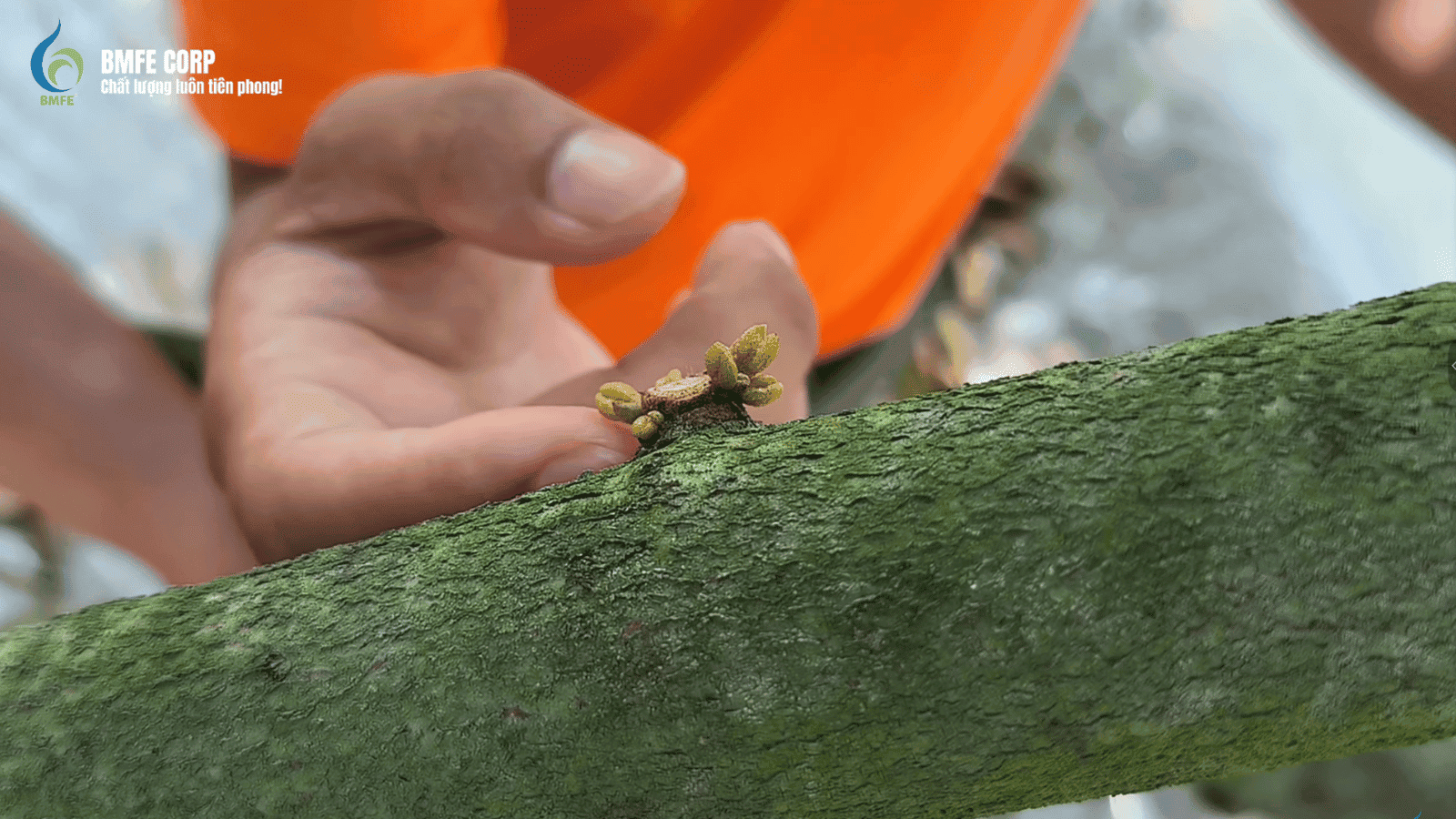
    phân biệt mầm lá và mầm hoa


    2. Signs to Identify Durian Flower Buds and Leaf Buds

    Flower Buds

    • Shape: Typically round, with clustered buds close together.

    • Size: Uniform development in clusters at leaf axils, appearing like “crab eyes.”

    • Characteristic: Not pointed; they form high-quality flower bunches if properly cared for.

    Leaf Buds

    • Shape: Pointed tips and grow sparsely.

    • Size: Develop faster than flower buds and are easy to spot due to their shape.

    • Characteristic: Excessive leaf bud growth reduces flower quality and fruit set rate.


    3. Causes of Excess Leaf Buds Instead of Flower Buds

    • Improper Bud Induction:
      Without proper nutrition, especially Potassium or DB (Diammonium Phosphate), the tree favors leaf over flower buds.

    • Humidity and Weather Conditions:
      Prolonged rain and high humidity hinder nutrient uptake, encouraging more leaf bud development.

    • Improper Pruning Time:
      Pruning young branches too early can trigger more leaf buds.

    • Poor Leaf Quality Control:
      Immature or weak leaves during the bud induction phase reduce flower bud development.


    4. Solutions for Excess Leaf Buds

    • Step 1: Proper Care During Bud Induction

      • Apply fertilizers rich in Potassium and DB.

      • Ensure trees have accumulated enough nutrients before the bud stage.

    • Step 2: Manage Moisture and Weather

      • Cover trees during heavy rain and supplement nutrients with foliar sprays.

      • Reapply lightly after rain if needed to maintain effectiveness.

    • Step 3: Ensure Branches and Leaves Are Mature Before Pruning

      • Only prune when new shoots are fully mature and leaves are fully developed.


    5. Tips to Increase Flower Bud Ratio

    • Choose the right timing when trees have balanced nutrients, humidity, and temperature.

    • Ensure mature, dark green leaves before bud induction.

    • Use fertilizers rich in Potassium and Phosphorus, avoid high Nitrogen which promotes leaf buds.

    • Spray bud-inducing chemicals at the correct dosage—not too diluted or concentrated.


    6. Conclusion

    Being able to distinguish between durian flower and leaf buds is vital to increasing both yield and fruit quality. Farmers should focus on proper care during the bud induction phase, ensure balanced nutrition, and manage environmental conditions effectively.

    For technical support or product recommendations, please contact BMFE Corp for detailed consultation.

    News

    SOIL MOISTURE AND PH SENSORS: SMART TOOLS TO HELP FARMERS CULTIVATE MORE EFFECTIVELY

    SOIL MOISTURE AND PH SENSORS: SMART TOOLS TO HELP FARMERS CULTIVATE MORE EFFECTIVELY

    INTERCROPPING AND RELAY CROPPING: MAXIMIZING LAND USE – SUSTAINABLE INCOME BOOST FOR FARMERS

    INTERCROPPING AND RELAY CROPPING: MAXIMIZING LAND USE – SUSTAINABLE INCOME BOOST FOR FARMERS

    CROP ROTATION AND CROP DIVERSIFICATION: SUSTAINABLE SOLUTIONS FOR HEALTHY SOIL AND HIGH YIELDS

    CROP ROTATION AND CROP DIVERSIFICATION: SUSTAINABLE SOLUTIONS FOR HEALTHY SOIL AND HIGH YIELDS

    ORGANIC AND BALANCED N-P-K FERTILIZATION: THE KEY TO HEALTHY PLANTS AND HIGH YIELDS

    ORGANIC AND BALANCED N-P-K FERTILIZATION: THE KEY TO HEALTHY PLANTS AND HIGH YIELDS

    WATER-SAVING MANAGEMENT – ALTERNATE WETTING AND DRYING (AWD) FOR RICE CULTIVATION

    WATER-SAVING MANAGEMENT – ALTERNATE WETTING AND DRYING (AWD) FOR RICE CULTIVATION

    RICE THRIPS (STENCHAETOTHRIPS BIFORMIS): IDENTIFICATION, SYMPTOMS, AND CONTROL METHODS

    RICE THRIPS (STENCHAETOTHRIPS BIFORMIS): IDENTIFICATION, SYMPTOMS, AND CONTROL METHODS

    CITRUS TREES – COMMON PESTS AND DISEASES & CONTROL MEASURES

    CITRUS TREES – COMMON PESTS AND DISEASES & CONTROL MEASURES

    MUSTARD GREENS AND CABBAGE – MAJOR PESTS (ARMYWORM, DIAMONDBACK MOTH, APHIDS): EFFECTIVE CONTROL METHODS

    MUSTARD GREENS AND CABBAGE – MAJOR PESTS (ARMYWORM, DIAMONDBACK MOTH, APHIDS): EFFECTIVE CONTROL METHODS

    BLACK PEPPER – QUICK WILT DISEASE (ROOT ROT CAUSED BY PHYTOPHTHORA): SYMPTOMS AND MANAGEMENT

    BLACK PEPPER – QUICK WILT DISEASE (ROOT ROT CAUSED BY PHYTOPHTHORA): SYMPTOMS AND MANAGEMENT

    COFFEE – HEMILEIA RUST DISEASE: DAMAGE AND MANAGEMENT TECHNIQUES

    COFFEE – HEMILEIA RUST DISEASE: DAMAGE AND MANAGEMENT TECHNIQUES

    DURIAN – ANTHRACNOSE ON LEAVES AND FRUITS: PREVENTIVE MEASURES

    DURIAN – ANTHRACNOSE ON LEAVES AND FRUITS: PREVENTIVE MEASURES

    MANGO – ANTHRACNOSE AFFECTS THE ENTIRE TREE: HOW TO IDENTIFY AND CONTROL

    MANGO – ANTHRACNOSE AFFECTS THE ENTIRE TREE: HOW TO IDENTIFY AND CONTROL

    Brown Planthopper and Rice Grassy Stunt Disease: Identification and Prevention Guide

    Brown Planthopper and Rice Grassy Stunt Disease: Identification and Prevention Guide

    White-Backed Planthopper in Rice: Symptoms and Effective Control Measures

    White-Backed Planthopper in Rice: Symptoms and Effective Control Measures

    How to Restore Hardpan and Depleted Soil: Revive the Soil – Grow Strong Rice – Harvest Big

    How to Restore Hardpan and Depleted Soil: Revive the Soil – Grow Strong Rice – Harvest Big

    RICE BUG DAMAGE: THE SILENT THREAT TO GRAIN AFTER HEADING THAT MANY OVERLOOK

    RICE BUG DAMAGE: THE SILENT THREAT TO GRAIN AFTER HEADING THAT MANY OVERLOOK

    GRAIN DISCOLORATION IN RICE: HOW TO PREVENT TOTAL CROP LOSS AFTER HEADING

    GRAIN DISCOLORATION IN RICE: HOW TO PREVENT TOTAL CROP LOSS AFTER HEADING

    SMALL RICE LEAF FOLDER: HOW TO IDENTIFY & COMPLETELY CONTROL BEFORE YOUR FIELD IS DEVASTATED

    SMALL RICE LEAF FOLDER: HOW TO IDENTIFY & COMPLETELY CONTROL BEFORE YOUR FIELD IS DEVASTATED

    Grassy Stunt and Ragged Stunt Disease in Rice: Early Detection & Field-Based Prevention Methods

    Grassy Stunt and Ragged Stunt Disease in Rice: Early Detection & Field-Based Prevention Methods

    Sheath Blight in Rice: Early Detection & 6 Effective Root-Level Solutions

    Sheath Blight in Rice: Early Detection & 6 Effective Root-Level Solutions

    CONQUER RICE BLAST DISEASE (LEAF BLIGHT) – 7 SIMPLE STEPS FOR A BUMPER HARVEST

    CONQUER RICE BLAST DISEASE (LEAF BLIGHT) – 7 SIMPLE STEPS FOR A BUMPER HARVEST

    BMFE WISHES YOU A HAPPY ĐOAN NGO FESTIVAL 2025

    BMFE WISHES YOU A HAPPY ĐOAN NGO FESTIVAL 2025

    Zalo
    Hotline
    Go Top